

What is a bevel gear
A bevel gear is a mechanical part for transmitting rotational motion, and is characterized by the conical shape of its gear faces. This special shape allows bevel gears to be driven with different shaft angles, which can usually vary between 0° and 90°. Compared to spur gears, bevel gears are better adapted to the requirements of the space layout, which is a clear advantage in cases where a compact structure or different shaft directions are required.
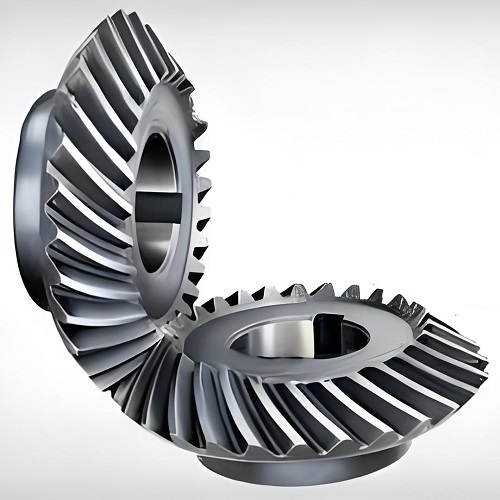
The operating principle of bevel gears is based on the meshing of gears. When a bevel gear rotates, its teeth mesh with the teeth of another meshing bevel gear. Through this tooth-to-tooth transmission, power is transferred from one shaft to the other. In the transmission process, a certain amount of friction will be generated between the teeth of the bevel gears, and this friction is the key to the realization of power transmission. At the same time, in order to ensure the smoothness and reliability of the transmission, the bevel gear tooth shape design needs to be very precise, usually using standard tooth shapes such as involute tooth shapes to reduce wear and noise.
Types of Bevel Gears
With the continuous progress of modern technology, there are many types of bevel gears such as the following
Straight-toothed Bevel Gear
Straight bevel gears are the most basic type of bevel gears, whose teeth are arranged along the direction of the conical busbar in a straight line shape. Straight bevel gear transmission is smooth, less noise, can transmit a larger torque, suitable for low and medium-speed transmission occasions, such as automobile differentials, machine tool spindle box. In straight bevel gears, the tooth profile of the gear teeth for the involute, this tooth profile shape can ensure the smoothness and accuracy of transmission. The processing of straight bevel gears is relatively simple and the cost is low, so they are widely used in some mechanical transmissions that do not require high precision.
Helical Bevel Gear
The teeth of helical bevel gears are inclined at a certain angle to the conical bus, and the inclined design makes the helical bevel gears mesh better in the transmission process, and the contact line is changed from a point contact to a line contact, which improves the transmission's load bearing and smoothness, and the helical bevels have a higher transmission efficiency and a lower noise compared with the straight bevel gears on the top, and are suitable for high-speed and heavy-duty transmission occasions. But the processing cost is high and difficult.
Zero degree bevel gear
Zero degree bevel gear is a special bevel gear, the helix angle of its teeth for zero degrees, that is, the teeth are arranged along the direction of the conical bus, was a straight line shape. Zero degree bevel gear in the transmission process has and straight bevel gear similar characteristics, transmission is smooth, less noise, but its bearing capacity and transmission efficiency is higher than straight bevel gear. Zero degree bevel gears are suitable for some of the transmission smoothness and load capacity requirements of higher occasions, such as engineering machinery, heavy machinery and so on.
In addition to the above several common types of bevel gears, there are some special-purpose bevel gears, such as spiral bevel gears, hypoid bevel gears and so on. These bevel gears in a specific mechanical transmission system has a unique advantage, to meet the different needs of the work.
Manufacturing process of bevel gears
Usually, the raw material is first processed into a cone shape, and then the teeth are processed on the cone surface. The processing process requires strict control of tooth pitch, tooth shape error, tooth surface roughness and other parameters to ensure the quality and performance of the bevel gear. In order to improve the wear resistance and service life of the bevel gear, surface treatment, such as quenching, carburizing, etc. can also be carried out.
The production process of bevel gears mainly includes the following steps:
Materials
Commonly used materials include alloy steel, carbon steel, cast iron and copper alloy, and suitable materials are selected according to the usage requirements.
Rough machining
The raw materials are forged or cut into blanks, which are initially processed into gear blanks through turning and milling.
Gear Shape Processing
Use specialized gear processing equipment, such as hobbing machine, gear planer or gear grinding machine, to process the tooth shape of gears.
Heat treatment
Hardening, tempering or carburizing the gears to enhance the hardness and wear resistance.
Finishing
Including grinding, polishing and inspection to make the gear precision and surface quality meet the requirements.
Finally, the bevel gears are test fitted and performance tested to ensure that they can operate properly.
Differences between bevel gears and other gears
Structure: Bevel gears have conical gear faces and are suitable for transmissions with intersecting axes, while other gears are usually used for longitudinal axis transmissions.
Transmission: Bevel gears are suitable for changing the transmission direction, while spur gears and helical gears are more suitable for linear transmission occasions.
Manufacturing: Bevel gear due to the complex structure, finishing and installation of higher technical requirements.
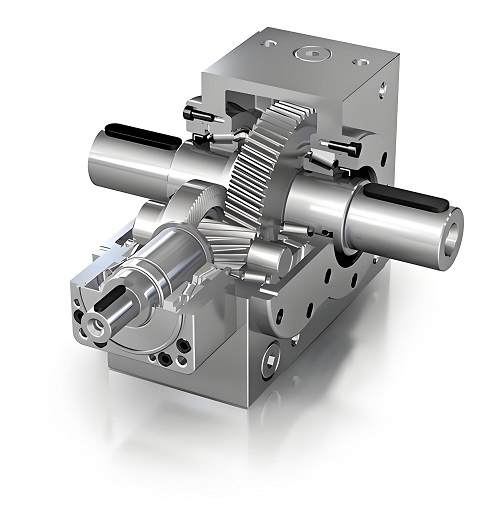
Application of Bevel Gear
Bevel gear rotors have functions that are widely evaluated in the following fields:
Automotive industry
Used in differentials, it enables the left and right wheels to rotate at different speeds, adapting to the vehicle's movement needs when turning. When the vehicle turns, the inner wheels need to travel a shorter distance than the outer wheels. Bevel gears realize this function through clever ratio adjustments to ensure smooth steering of the vehicle.
Mechanical equipment
Including machine tools, cranes, transmission equipment, etc., need to change the transmission direction of the occasion, can adapt to the harsh working environment of mechanical equipment.
Aerospace
Used in aircraft for directional, high-strength transmission devices, can meet the aerospace field on the strict requirements of the parts, for the safe flight of the aircraft to provide a guarantee.
Shipbuilding
Used in drive and rudder systems to help adjust transmission paths.
Bevel gear with its excellent performance and configuration of the type, become an important part of the base of the mechanical transmission, for the development of modern industry to provide a sophisticated technical support. With the continuous progress of science and technology, the design and manufacturing technology of bevel gears are also constantly innovating and improving, and will make greater contributions to the development of more fields.
jeek is a Chinese precision manufacturing company with very high achievements in the field of gears, if you have a need, you can provide the drawings of the gears that need to be manufactured, send them to us in the form of e-mail, and we will provide quotations in time.